
Patancheru Is Mid-Pivot, and the Edges Are Where It Shows
An industrial town does not fade; it pivots. Patancheru's pivot is visible at its southern and western edges, where the discount is real, the environmental history is public, and the street matters more than the corridor.
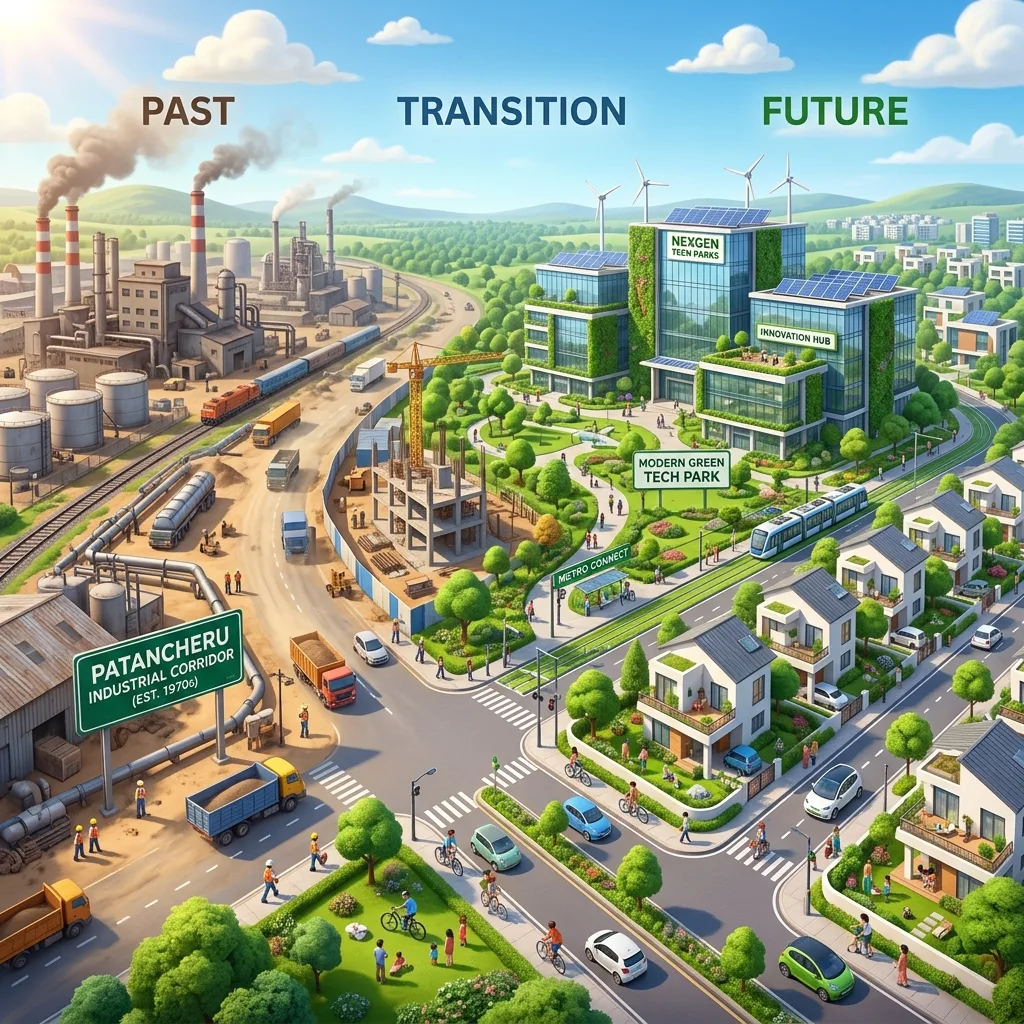
At half past three on a weekday the service road off NH-65 fills with buses. Shift change. Men in company-issue shirts step down, cross to the tiffin stalls, and a line of tankers waits behind them for the gate to clear. Two kilometres further west the same road runs past a field with a layout board planted at the corner and nothing built on it yet.
Both scenes are Patancheru. Which one you are buying into is decided by about four minutes of driving.
Industry arrived here decades before software did
Patancheru's rise predates Hyderabad's IT story entirely. Industrial estates established along National Highway 65 — the Mumbai highway — drew manufacturing, engineering and chemical units to a place where land, labour and logistics met. The BHEL township at Ramachandrapuram anchored a generation of public-sector employment. Around those anchors grew what real industry always grows: suppliers, transporters, workshops, worker housing, and the everyday commerce that feeds them.
That first act gave the western periphery a payroll before the IT corridor existed. It also built the road culture and bus connectivity the area still runs on. Patancheru became a place where things are made, and that identity has outlasted several fashions.
The inheritance is genuinely double-edged
On the credit side: employment that does not evaporate with one industry's cycle, civic infrastructure that is good by the standards of peripheral Hyderabad, functioning markets and services across a broad income range, and land parcels at a scale purely residential corridors rarely assemble.
On the debit side: an environmental record that has been the subject of public discussion for decades. Patancheru's history of industrial effluent and its effect on local water bodies is documented in public discourse, litigation and official monitoring. No honest account of this geography can route around it, and a property article that tries to is telling you something about the writer rather than the place.
The environmental question is real, and it is parcel-specific
Three things can be said without pretending to adjudicate a matter that belongs to monitoring data rather than a property essay.
The legacy is real and public. Anyone who suggests otherwise is either uninformed or hoping you are.
Legacy is not the same as destiny. Regulatory tightening, treatment infrastructure and the slow outward migration of heavy industry have been changing the area's profile for years. Trajectory matters alongside starting point.
And the risk varies enormously across the mandal. Proximity to active or former units, groundwater conditions, and a parcel's own use history are not uniform across a large industrial belt. Which is why the only serious approach is parcel-level environmental diligence commissioned by the buyer, alongside the usual title search, rather than a general judgement waved at the whole area.
The stigma itself is part of the arithmetic, incidentally. Markets reprice reputations more slowly than they reprice realities — in both directions, which is exactly why this is not a comfortable trade.
The second act is being built on the ring, not the highway
The first act ran along NH-65. The second is being built at Exit 3 of the Outer Ring Road, on the Patancheru side.
An interchange on a 158-kilometre ring is a valve. It decides where the city's pressure releases outwards. Exit 3 puts this side of the periphery at a junction of three things at once: the NH-65 corridor running towards Mumbai, the ring binding the city together, and the westward roads feeding Shankarpally and Tellapur.
Logistics reads that geometry before anyone else does. Warehousing, transport yards and highway commerce want ring access, national-highway frontage and land at pre-urban prices, and this junction offers all three.
Warehousing is the first evidence, and it arrives with lorries
The clearest sign of the pivot is not residential at all. It is sheds.
For a land investor those sheds carry two useful signals. They bring formal employment and formal infrastructure — widened approach roads, power reliability, perimeter security — which residential development later inherits without paying for. And they are dated markers: institutional logistics capital underwrites on ten-year horizons, so its arrival tells you what patient, well-researched money concluded about this junction.
The counterpoint is obvious the moment you stand there. Logistics means freight movement. A street that serves loading bays by day is not a residential approach, whatever the layout brochure says about connectivity. The residential opportunity here sits near the connectivity and away from the bays, which is one more reason the street governs everything.
Ask about water before you ask about price
In an industrial belt, water is the diligence item that separates a serious buyer from a hopeful one, and it is the one most often deferred until after registration.
Establish where the drinking supply will actually come from. A piped municipal connection has a traceable source and a treating authority behind it. A layout dependent on borewells has neither, and the answer "we have a borewell" is not an answer — the questions are how deep, drawing from which aquifer, and tested by whom.
Commission an independent water test on the specific parcel rather than accepting a certificate produced by the seller. A laboratory report costs very little against the size of the transaction, and it is the only document in this belt that speaks to the concern people actually have.
Ask the neighbours, too. Households already living within a kilometre have a decade of experience with what comes out of the tap in April, and they have no incentive to shade the answer.
Then read the result against the parcel's own history and its surroundings, because groundwater conditions in a large industrial mandal are local rather than uniform. A good report on one street settles nothing about the street behind it.
In Patancheru, the street matters more than the corridor
Transitions happen at edges, and this map rewards close reading.
The industrial core along the highway will stay industrial for the foreseeable future, and should. That economy is the area's foundation. The transition is happening in the arcs around it — south and west, where Patancheru's connectivity meets the plotted corridors of Tellapur, Mokila and Shankarpally, and where households priced out of the inner west are already buying.
Two parcels four kilometres apart can occupy different worlds. One faces a working unit and a tanker route. The other faces open farmland on a road to a gated layout. Elsewhere in West Hyderabad you can reason at corridor level and be roughly right. Here that method will lose you money.
The practical form of this is a short discipline. Walk the ring of streets immediately around any parcel you are considering — not the approach road the salesperson drives you along, but the two streets behind it and the one leading away. Note what occupies each frontage today and what the master plan permits there tomorrow. Those two facts, gathered in twenty minutes, tell you more about the parcel's next decade than any corridor-level argument, including this one.
The premium buyer has not arrived, and that gap is the whole trade
Patancheru's residential demand is more layered than outsiders assume. Its own industrial workforce — supervisors, engineers, small-business owners — forms the base and always has. Above that sit households priced out of Tellapur and Miyapur looking for connected affordability, logistics professionals following their industry to the ring, and investors reading the Exit 3 geometry early.
What the area does not draw in numbers is the villa buyer who chooses Shankarpally or Mokila for openness, schools and community. That absence is what the price gap between Patancheru's edges and the plotted corridors beside it measures. The investment argument here is a view on whether that gap narrows, and how slowly.
The everyday civic layer is better here than in a greenfield corridor
This is the advantage nobody advertises. Patancheru is an established municipal town, which means public services, markets, everyday healthcare and schooling that a raw frontier location takes a decade to assemble.
What it does not offer is the premium tier. The international-curriculum schools and organised healthcare brands that anchor family decisions in the west's plot corridors sit a corridor away, in the Mokila–Tellapur belt. Reachable, not local.
Families should audit their actual weekly needs against the town's real inventory before deciding. Investors should note the inverse: when that premium layer does start opening here, the second act will have moved from thesis to fact, and the discount will already be closing.
Some industrial fringes turn; some stall for a generation
Hyderabad has run this sequence before. Stretches of its older western and northern periphery that the city now reads as ordinary residential fabric began as industrial-adjacent land that families colonised for affordability and access. Industry builds the roads and the payroll, housing follows the workforce, services follow the housing, and eventually the industrial identity survives only in place names.
The failure mode deserves equal billing. Fringes with weak environmental stewardship or chaotic land use can stall mid-transition — neither industrial enough to prosper nor residential enough to re-rate — and stay stalled for twenty years. Which path a particular edge takes turns on variables a careful buyer can actually inspect: zoning discipline, environmental condition, and whether organised residential development is landing there or merely being advertised there.
If you buy here, the sequence is stricter than usual
Verify layout approval in documents — HMDA or DTCP, proceedings number, sanctioned plan — never in conversation.
Commission parcel-level environmental checks alongside a title search by an advocate you appoint, not one the seller recommends.
Read the master plan's land-use zoning for the surrounding parcels, not only your own. Your neighbour's permitted use is your future view, and it is a matter of public record.
Visit at working hours, when the industrial economy is audible and the tankers are moving. Decide whether you are content with the area as it is today, because that is the only defensible basis for the purchase.
And time the entry honestly. Transition corridors reward buyers who arrive after the direction is confirmed and before pricing acknowledges it — after logistics parks and layout approvals show which edges are turning, before the retail brands announce it to everyone. That window is read in approval registers, land-use notifications and the opening dates of institutional facilities. All public, all tedious. A buyer unwilling to do that reading should not attempt a transition corridor at all, because the discount is payment for the homework.
Where we stand, since we are next door
Next Edge Realty's communities sit in the Shankarpally corridor: Sanctuary, forty-five HMDA-approved acres at Julkal, and Raghunath County on the Shankarpally–Mehtabkhan Guda–Mominpet road. Both draw on Exit 3's connectivity while sitting apart from Patancheru's industrial core in land use, environment and setting. We benefit from this geography improving, and you should read the preceding sections knowing that.
The relationship between the two is complementary rather than competitive. Patancheru's employment and logistics base strengthens the corridor's economy. The corridor's residential quality gives Patancheru's professionals somewhere to move to. When we argue that West Hyderabad's fundamentals are the city's strongest, this unglamorous industrial economy is part of the evidence rather than an exception to it.
Patancheru will not become fashionable soon and does not need to. Its edges hold real asymmetry for a selective, patient buyer with an environmental consultant on retainer. A family wanting a finished environment should look a few minutes further west and pay the difference without regret. Both are respectable conclusions, and the wrong one is choosing between them from a brochure.
Drive it at three in the afternoon, on a working day, with the windows down. Then book a site visit or reach us directly if you want the corridor beyond the exit explained on the ground.
Environmental condition, title and approval verification are the buyer's responsibility on any specific parcel. Nothing here substitutes for professional advice, and land investments are subject to market conditions.