
Ask a Broker Which Is Better and He Names His Inventory
Mokila and Shankarpally share a road, a commuting pattern and a buyer. They are markets at completely different stages of life, and the choice between them is really a choice about where on the development curve you want to enter.
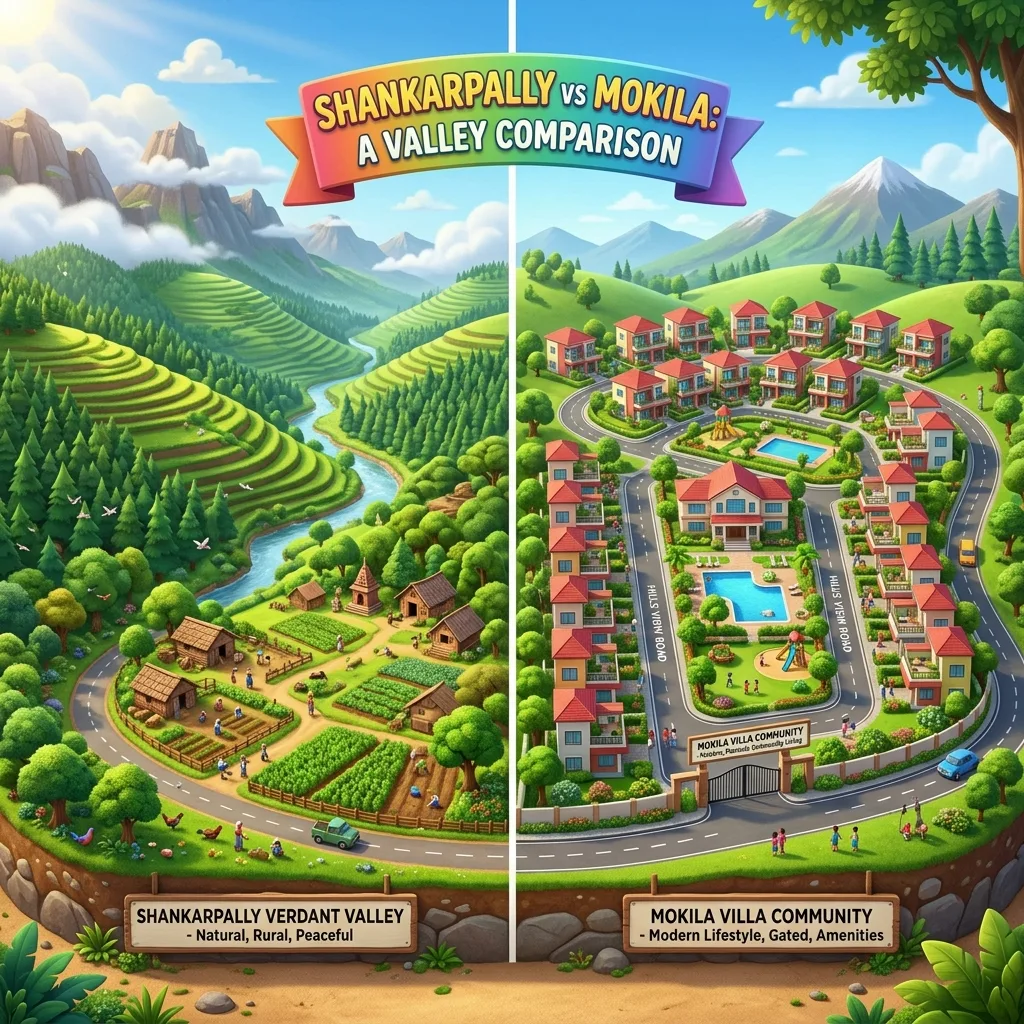
"Both are good, sir. But Mokila is proven."
The broker who said that had four Mokila plots on his list and none in Shankarpally. The advice was not dishonest. It was simply his inventory, spoken aloud.
Mokila and Shankarpally sit close enough to share a road, a commuting pattern and a buyer profile. They are far enough apart to be markets at completely different stages of life. Choosing between them is the commonest dilemma we hear, so this piece takes it seriously — including the parts that do not favour us.
Our disclosure, up front: Next Edge Realty develops in Shankarpally. Read accordingly, then go and stand in both places. Land arguments are settled on the ground, not on a webpage.
One corridor running on two clocks
Geographically this is a single westward corridor out of Gachibowli and the Financial District, past the Tellapur and Kollur turnings, through Mokila, and on towards Shankarpally town. The drive between the two is a matter of minutes, not a change of world.
Economically the clocks differ. Mokila's development cycle began in earnest more than a decade ago and is deep into consolidation: communities occupied, schools operating, retail arriving. Shankarpally's cycle is younger — layouts newer, occupancy thinner, the town's character still being negotiated between its older self and its incoming residents.
You are not choosing between two villages. You are choosing where on the development curve to enter.
Mokila's strengths compound each other
The school cluster is the anchor. Institutions of the calibre of Glendale, Samashti and Epistemo operate in or near the Mokila–Tellapur belt, and families organise their lives around school runs with a discipline no other amenity commands. We have written separately about how the school belt shapes this corridor, because it is the most underrated force in West Hyderabad land pricing.
Then occupancy. Mokila has crossed the threshold where communities are lived in rather than merely sold out. Lived-in communities generate their own gravity — domestic help networks, tuition teachers, clinics, groceries — which makes each subsequent family's decision easier.
And liquidity. A Mokila plot needs no explanation to a future buyer, and assets that need no explanation sell faster and at tighter spreads.
If your priority is to build within two or three years and live there while children attend nearby schools, Mokila is a strong answer. We will not pretend otherwise.
Every one of those strengths is also a price
Mokila's certainty has been thoroughly discovered, and discovery is expensive. The parcels that made the corridor famous — generous plots on quiet internal roads — went to earlier buyers. Much of what reaches the market now is smaller, denser, or resale stock carrying a maturity premium.
There is a subtler cost too: crowding of the amenity base. Roads laid out for a village now carry a township's traffic, and school-run congestion at peak hours is a daily consideration rather than a footnote.
None of that makes Mokila a poor purchase. It makes it a fully priced one, where the return profile leans on continued momentum rather than on a re-rating that has largely already happened.
Shankarpally's case rests on three legs
The first is infrastructure that most frontier corridors merely promise. A working suburban rail station on the Hyderabad–Vikarabad line, which is rare among Hyderabad's plotted corridors and which we examine at length in the MMTS factor. ORR Exit 3 on the Patancheru side within practical reach. IIT Hyderabad at Kandi roughly twenty-five minutes away, seeding the area with faculty, researchers and the start-ups that cluster around such institutions.
The second is plot economics. Because the corridor is a stage earlier, the sizes that have vanished from Mokila remain available. At Sanctuary, our HMDA-approved community at Julkal, plots run from 200 to 750 square yards with pricing from ₹45 lakh — a threshold at which a professional household can buy land and hold it without strain. Raghunath County, DTCP-approved, faces the 100-ft Shankarpally–Mehtabkhan Guda–Mominpet road with 40-ft and 33-ft internal CC roads, widths that denser later-stage layouts rarely afford.
The third is optionality. The proposed Regional Ring Road, its northern section approved as NH-161AA, would place the belt advantageously within the city's next orbital geometry. We treat that as upside rather than base case. At today's entry point the option costs nothing.
Shankarpally's costs, stated without softening
The daily-convenience layer is thin. Supermarkets, cafés and clinics that Mokila now takes for granted are arriving rather than arrived. A family building immediately should plan around Mokila's amenity base for some years. That is workable, since it is minutes away, but it is a dependency worth naming out loud.
The commute is the second cost. If your office is in HITEC City or the Financial District, Shankarpally adds real minutes over Mokila on the same road, every working day. Rail softens this for those whose timings align with the suburban timetable. Road commuters should drive the route at peak hour before committing, not after.
Third, time. Shankarpally's thesis is a five-to-ten-year thesis. If your capital or your patience runs on a two-year cycle, this is the wrong corridor — and plotted land may be the wrong asset entirely.
The school question has a present answer and a future one
Because it decides so many buyers, this deserves a verdict.
Today Mokila wins it. The established institutions cluster on its side of the corridor, and proximity to a school gate at twenty to eight in the morning is worth more than any brochure adjective. Shankarpally families currently drive to that belt — a manageable run, but Mokila's is shorter.
The forward-looking counterpoint is that school ecosystems follow rooftops. As Shankarpally's occupancy thickens, the institutional gap should narrow, as it did in Mokila itself a decade ago. "Should" is doing work in that sentence; nobody can promise a specific school will open.
Buyers with school-age children today should weight the present. Buyers whose children are infants, or whose plot is an investment, can afford to weight the trajectory.
Road against rail
Mokila's connectivity story is purely road-borne, and a good one: closer to the employment core on the same westward artery.
Shankarpally's is road plus rail — further out on the same artery, but with a railway station offering a congestion-proof link for those whose routines can use it.
Which matters more depends on your household. A two-car family commuting to Gachibowli will feel Mokila's advantage daily. A household that values a rail fallback, or one buying for a horizon in which suburban rail frequencies typically improve, will price Shankarpally's dual-mode position higher than the market currently does.
The utilities beneath decide more than the roads above
Corridor debates fixate on schools and traffic, yet the systems below ground govern more of daily life than either.
Both Mokila and Shankarpally sit outside the city's piped-water heartland. Layouts across the corridor rely on a managed mix of borewells, community storage and tanker top-ups while regional supply schemes extend westwards. That is the honest position for both ends, and it is not a win or a loss for either.
The difference is generational rather than geographic. Mokila's denser occupancy forced its communities to mature their water management earlier, sometimes retrofitting what should have been designed in. Newer Shankarpally layouts build with the lesson already learnt. At Sanctuary, underground water, electricity and drainage networks and rainwater harvesting were laid as base infrastructure before plots were handed over, rather than appended afterwards.
Power tells a similar story. Both ends draw from the same regional feeders, and reliability differences come down to a layout's own cabling, transformer capacity and earthing rather than its postcode.
Our advice is identical for any developer, ourselves included: ask to be shown the substation arrangement and the underground work, not told about it. Utilities are the one amenity you cannot photograph and the one you live with hourly.
Two different textures of daily life
Spend an unhurried afternoon in each and the difference emerges.
Mokila's commercial strip has the tidy look of a young suburb: supermarkets, pharmacies, bakeries, gyms and cafés opened specifically to serve gated-community residents. Convenient, pleasant, and getting denser.
Shankarpally offers a working town's bazaar economy — older, untidier, and more complete in the essentials than first-time visitors expect. Produce markets, hardware merchants, banks, clinics and everyday schools have served this town for generations. What it lacks is the polished layer: the branded grocer, the weekend brunch spot.
Households weigh this differently and honestly should. For daily provisioning, a functioning town beats a boutique strip. For lifestyle texture and visiting in-laws, the strip wins.
What the rental market whispers
Neither is a rental market in the apartment-block sense, but rental signals still carry information. They reveal who needs to live in a place rather than who is speculating on it.
In Mokila, completed villas let readily to families organising around the school belt — demand that is sticky, seasonal around admissions, and underpinned by the institutions themselves. In Shankarpally, tenancy clusters around the town's own institutional and working economy, with the IIT Hyderabad ecosystem at Kandi adding a quiet academic tenancy nearby.
For a plot buyer the reading is simple. Mokila's rental depth confirms its consolidation. Shankarpally's thinner, more local base confirms it is earlier. Investors banking on interim rental income should favour Mokila or lower their assumptions. Investors holding land as land lose nothing either way.
Drive the pinch points, not the average
Both corridors are described in average minutes, and averages hide the thing that actually decides your mornings.
The westward artery does not slow uniformly. It pinches at specific places — a school gate at the hour of the school run, a junction where turning traffic backs up, a stretch under widening, a market crossing that fills on certain days. The difference between a tolerable commute and an intolerable one is usually two of those points rather than the total distance.
So drive it, twice. Once outbound at the hour you would leave home, once inbound at the hour you would return, and note where you actually stop rather than where you expected to. Mokila's pinch points cluster around school timings. Shankarpally's have more to do with the market stretch and the approach roads.
Then ask the question the map cannot answer: does the rail option apply to you? The suburban trains are genuinely useful for households whose timings align with them and largely irrelevant for those whose do not, and only a timetable and your own working hours can settle which you are.
Exit deserves cold-eyed treatment
Mokila resales move faster today. That is what maturity buys.
Shankarpally's resale market is younger and spreads can be wider, which matters if a forced sale is conceivable in your circumstances. Against that, earlier-stage corridors have historically offered the larger re-rating between purchase and eventual sale — the very spread Mokila's early buyers enjoyed.
You are choosing between a faster exit and a potentially better one. No honest adviser can promise both.
The tiebreaker is when you intend to build
Building immediately favours Mokila's ecosystem: contractors, materials, services and neighbours are all in place.
Holding for later favours Shankarpally, where entry price is kinder and the corridor matures alongside your patience. Both our communities are ready to construct with underground utilities in place, so the constraint is not the layout. It is the ecosystem around it, and that gap closes a little each year.
Choose Mokila if you will build within three years, school proximity is decisive now, and you accept a fully discovered price for a settled ecosystem.
Choose Shankarpally if your horizon is five years or longer, you want plot sizes and entry pricing the mature belt no longer offers, you value the rail link and the ring optionality, and you can tolerate an amenity layer still filling in.
If you are two buyers in one household with different priorities — a common situation — settle it on the ground. A site visit covering both ends of the corridor in one morning usually resolves what argument cannot.
Our position, plainly
We build in Shankarpally because we judge the combination of working infrastructure and undiscovered pricing to be the best risk-adjusted proposition in West Hyderabad today. That is a judgement, not a fact, and reasonable people weight the variables differently.
What we can state as fact: our layouts are HMDA and DTCP approved respectively, utilities are underground, and the documents are available for your advocate's inspection before a rupee changes hands. Verification of title and approvals remains the buyer's responsibility, and property values are subject to market conditions.
If you would like the corridor argued to your face rather than on your screen, get in touch. We will show you Mokila on the way.